


Over the last decade, Indian banking has achieved unprecedented digital scale. Institutions have heavily invested in core modernisation, UPI adoption, API infrastructure, and real-time omnichannel servicing. But as digital maturity skyrocketed, something else expanded quietly in the background: customer data.
For banks, data doesn’t sit in an isolated silo. It flows continuously across internet banking platforms, lending systems, payment switches, fraud engines, CRM environments, analytics models, and an expanding ecosystem of third-party service providers.
Enter India’s Digital Personal Data Protection (DPDP) Act 2023, and its associated compliance. Many institutions are waking up to a critical realisation: DPDP readiness cannot be achieved solely through consent. Privacy is no longer just a legal workstream; it is a bank-wide governance and operating model transformation.
Why Consent is Only the Starting Point?
When banks begin their privacy journeys, consent naturally becomes the focal point. Questions inevitably arise: How should consent be collected? Where should it be stored? How do we handle withdrawal?
While these are necessary questions, banking environments pose a much larger operational challenge. A consent event created during account opening does not remain isolated. That single decision trickles down, influencing downstream systems across loan servicing, payment processing, fraud analytics, and partner interactions.
If a customer withdraws their consent or exercises their data rights, systems must respond instantly. If the purpose of data usage changes, operational controls must adapt.
In short: Consent creates an obligation. Governance operationalises it.
Banks that treat privacy as a mere front-end consent collection exercise risk creating an isolated control layer that fails to influence their complex, distributed data landscape.
The Shift: From Static Privacy Controls to Dynamic Privacy Operations
Historically, compliance programs operated in periodic cycles. Policies were drafted, controls were implemented, audits measured compliance, and remediation followed.
That model worked when banking operated in slower cycles. However, modern banking is continuous. Customer journeys evolve daily, products launch faster, partner ecosystems expand constantly, and data moves instantly.
Consequently, privacy compliant with DPDP must evolve from static controls into dynamic operational workflows. Banks must be able to continuously answer operational requirements of DPDP with a keen focus on operational imperatives.
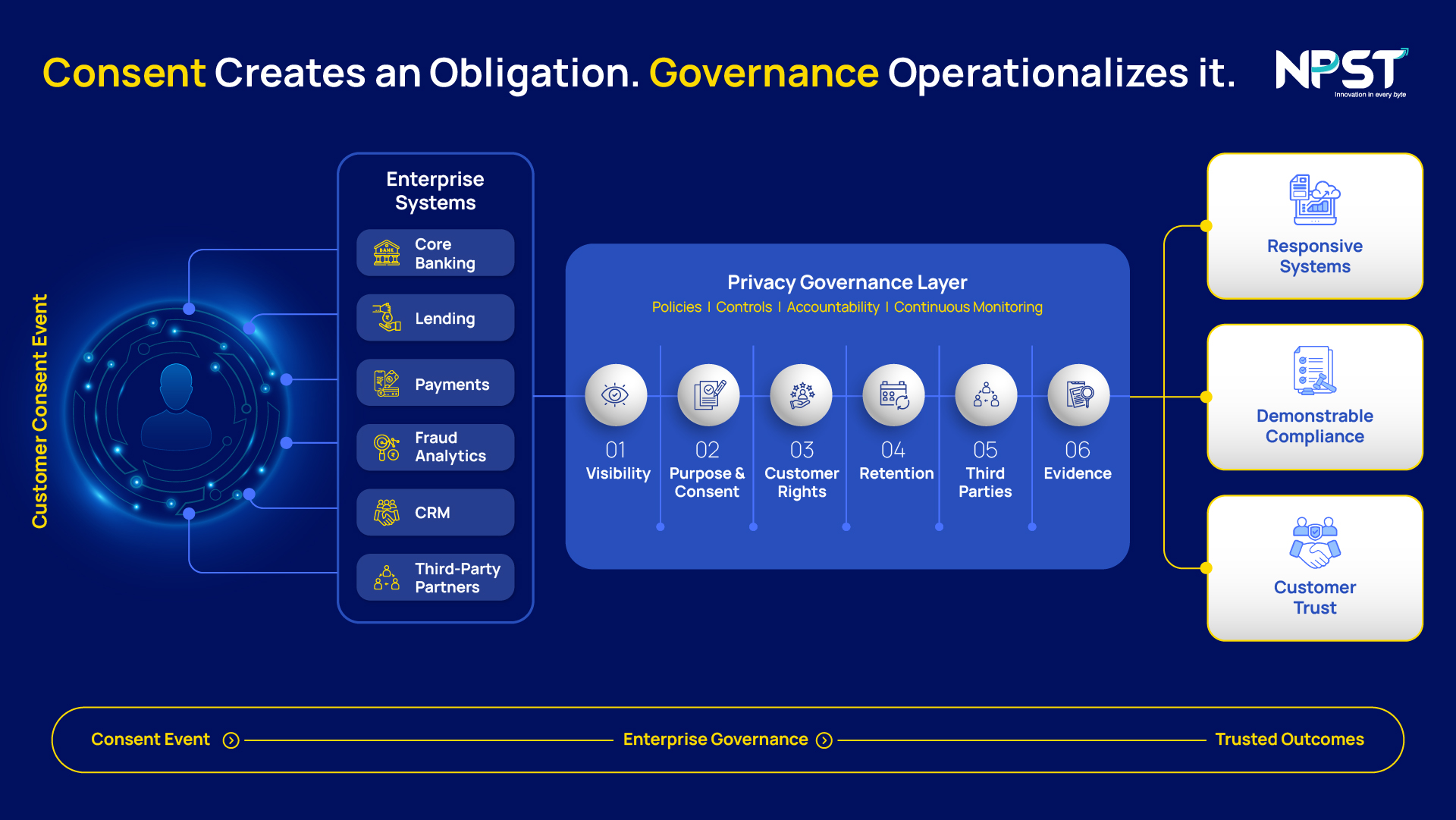
The Six Capabilities That Define DPDP Readiness for Banks
As Banks move from initial DPDP assessments to operational implementation, successful transformation programs are converging around six core capabilities:
- 1. Enterprise-Wide Visibility: Banks need a continuous understanding of where customer information resides, how it flows, and which processes interact with it across the enterprise.
- 2. Purpose and Consent Execution: Capturing consent is insufficient unless strict purpose controls and downstream enforcement exist across all systems.
- 3. Rights Operationalization: Handling customer requests for data access, correction, communication, and grievance management cannot remain a manual task. It requires automated lifecycle actions.
- 4. Retention Governance: Data retention obligations intersect across operational, regulatory, legal, fraud, and audit requirements. Executing data purging or archiving requires high-level coordination.
- 5. Third-Party Governance: Modern banking relies heavily on fintechs, cloud environments, and outsourcing partners. DPDP readiness extends to these service ecosystems.
- 6. Evidence Generation: Operational governance ultimately relies on the ability to demonstrate, on demand, what privacy decisions were made and exactly how they were executed.
Together, these six capabilities form the foundation of operational privacy governance in line with DPDP compliance.
Why Technology Alone Does Not Solve Privacy Transformation?
While DPDP solution modules are essential for bringing structure, automation, discovery, and reporting to the table, technology alone won’t solve the enterprise-level transformation required for DPDP compliance.
The challenges quickly become operational: How do we integrate consent with legacy core systems? How do we govern historical records? How do we align business ownership?
These challenges sit at the complex intersection of compliance, architecture, operations, and execution. The true value no longer lies merely in enabling controls; it lies in making governance executable across hundreds of distinct systems.
The NPST Perspective: Bridging Governance Intent and Operational Execution
At NPST, we understand that bank stakeholders require much more than a standalone compliance implementation to make their systems and processes DPDP-ready. For CIOs, DPDP readiness is an enterprise architecture problem. For compliance teams, it is a workflow challenge. For business leaders, it is a customer experience initiative.
Our approach helps banks operationalize privacy through a deep understanding of banking ecosystems. Privacy transformation sits directly at the intersection of:
- Banking operations
- Enterprise systems
- Payment infrastructure
- Governance workflows
- Implementation discipline
By focusing on enterprise integration, workflow orchestration, and governance execution, NPST ensures that privacy is deeply embedded into how your institution actually operates.
As we look toward the rest of 2026 and beyond, the future of banking will not be built solely on digital infrastructure. It will be built on a DPDP-compliant trusted infrastructure.
Partner with NPST to navigate your DPDP transformation journey with confidence. Connect with our DPDP experts today.
Explore More
May 27, 2026
Uncategorized,
Navigating India’s Next Payment Era: Strategic Imperatives from the RBI Payment Systems Report for 2026 and Ahead
Read More

January 30, 2026
Banks,
The Data Mine in the Kirana Store: Leveraging UPI QR for the Next Wave of Merchant Lending
Read More
January 14, 2026
Banks,
Consolidation and Growth: Decoding the RBI’s 2024-25 Trend & Progress Report on Banking in India
Read More
February 18, 2025
Banks,
Banking Super Apps: The Digital Bridge for India’s Regional Rural Banks
Read More
We empower banks and payment aggregators to achieve success at every step of the transaction journey
